


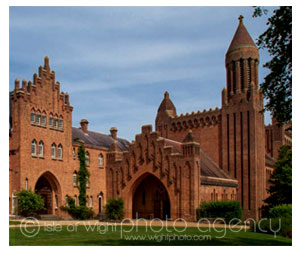
 The imposing buildings of Quarr Abbey impress themselves upon the mind of many visitors to the Isle of Wight. But few people know much about either the buildings or who built them.
Isle of Wight Digital Imaging Group (IWDIG) photographers were asked to take a few images for publication in the September (Autumn) 2012 Issue of Bricks Bulletin Magazine.
Read Article click here
The Architect & Building Of Quarr Abbey
Paul Bellot was born in Paris in 1876; the son of an architect, he studied at the Paris École des Beaux-Arts, graduating in 1900. In 1902 he entered the Benedictine community of Solesmes at Appuldurcombe on the Isle of Wight.
Dom Bellot was charged with the task of designing a new monastery on the site of a dissolved twelfth-century Cistercian abbey at Quarr. In 1907 the order bought Quarr Abbey House, to which they transferred in 1908. The church, was consecrated on 12th October 1912. Entered through a Dutch gabled frontage, it adopts a linear arrangement of portico, narthex, nave and sanctuary. (Image Above: Isle of Wight Photo Agency).
Adopting a simple and functional approach to the design. Bellot chose brick as the predominant material and the building derives its logic from this. Quarr Abbey was built entirely by local workmen, few of whom could have had any experience of building on such a scale or in such a style. Belgian bricks were imported partly to Dom Bellot’s familiarity with the bricks’ warmth and colour.
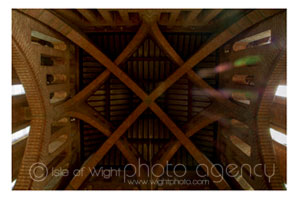 Left Intersecting brick arches in the roof above the sanctuary (Image: Isle of Wight Photo Agency).
The abbey adopts a traditional monastic plan with refectory, chapter house, monks’ cells and guest accommodation all arranged around the central armature of a cloister. The initial phase of building was completed 1908. While the exterior of the church is unadorned, Bellot was keen to express the interior volumes.
Bellot was at his best when working in brick and on revisiting Quarr in 1937 he declared it to be his finest work. While Bellot remains little known in the British Isles, his influence in continental Europe was considerable – After Quarr Bellot went on to realise some 30 projects in France, Belgium, The Netherlands and Portugal. He died in 1944 while completing the Oratoire Saint-Joseph in Canada and he is buried there.
